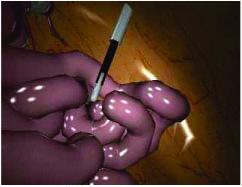
In this paper, we propose a new approach to simulate the small intestine in a context of laparoscopic surgery. The ultimate aim of this work is to simulate the training of a basic surgical gesture in real-time: moving aside the intestine to reach hidden areas of the abdomen. The main problem posed by this kind of simulation is animating the intestine. The problem comes from the nature of the intestine: a very long tube which is not isotropically elastic, and is contained in a volume that is small when compared to the intestine's length. It coils extensively and collides with itself in many places. To do this, we use a layered model to animate the intestine. The intestine's axis is animated as a linear mechanical component. A specific sphere-based model han- dles contacts and self-collisions. A skinning model is used to create the intestine's volume around the axis. This paper discusses and compares three different repre- sentations for skinning the intestine: a parametric surface model and two implicit surface models. The first implicit surface model uses point skeletons while the sec- ond uses local convolution surfaces. Using these models, we obtained good-looking results in real-time.